
Field Review | Artist Interview Series

In conversation with
Anjali Misra
Anjali Misra is an abstract impressionist whose practice explores the intersections of memory, perception, and embodied experience. Working with acrylic, ink, and a signature tactile base of organic coffee washes, she creates layered, atmospheric paintings that investigate how places, emotions, and movement continue to shape inner landscapes. Rather than depicting physical geography, her work captures how moments are remembered, transforming abstraction into a language for emotional resonance and quiet reflection.
Her multidisciplinary background in Philosophy, Ethics of Mental Health, and Interpersonal Communication deeply informs her studio inquiry. As a clinical hypnotherapist and long-time yoga practitioner, Anjali brings a heightened sensitivity to the dialogue between mind and body, while the expressive vocabulary of classical Odissi dance inspires the fluid rhythm and gesture within her compositions. Central to her work is the concept of Micro-Clarity—an attentiveness to immediate, tactile details and sensory anchors that builds both artistic depth and personal resilience.
Working from her studio in Gurugram, Anjali approaches painting as an intuitive yet deeply reflective process. Through fluid mark-making, layered surfaces, and a grounded organic palette, she creates immersive visual spaces that invite contemplation rather than immediate resolution. Her recent series—including Landscape of Consciousness, Near the Lake House, and Elysian Trails—explore memory not as a static record of the past, but as a living, evolving experience. Through her practice, Anjali invites viewers to slow down, anchor in the nuance of the present detail, and reconnect with the quiet landscapes within themselves.
From:
India
Artist Statement
Memory is rarely faithful. It edits, softens and rearranges until a place is no longer remembered for its geography, but for the feeling it leaves behind. A line of light. The rhythm of leaves. A colour that quietly becomes inseparable from an emotion.
Anjali Misra’s practice inhabits this space between recollection and presence. Working intuitively with layered acrylics, fluid mark making and organic materials, she allows paintings to emerge through rhythm rather than resolution. Each surface carries traces of its own evolution, where what is concealed becomes just as significant as what remains visible.
Her background in philosophy, clinical hypnotherapy and yoga has shaped the way she approaches painting, encouraging an attentiveness to perception, embodied memory and the subtle dialogue between mind and body. The expressive language of Odissi dance continues to inform the movement within her compositions, where gesture becomes a way of thinking as much as a way of making.
Rather than offering fixed narratives, her paintings remain deliberately open. They invite viewers to inhabit a space where landscapes dissolve into impressions, memory drifts into abstraction, and the familiar is experienced anew. If the works ask anything, it is simply this: what do we truly carry with us when everything else has faded.
Tell us about yourself and your artistic background.
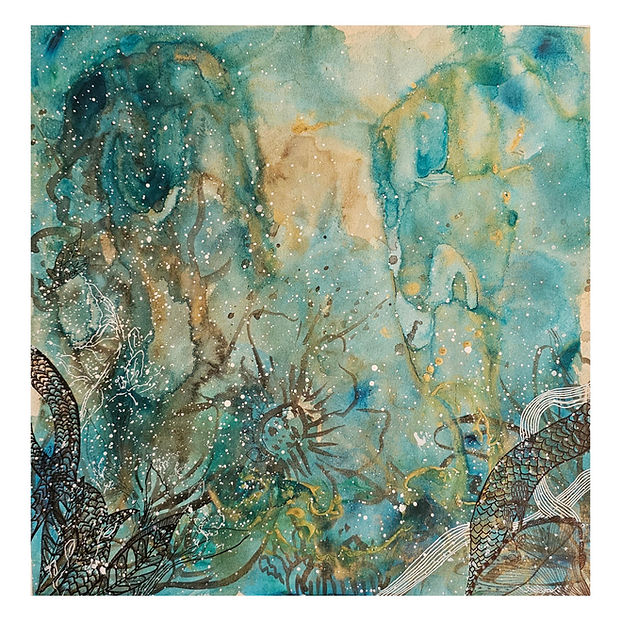
My path as an artist isn't linear, and that is precisely what gives the work its character. Based in Gurugram, my practice explores how memory and awareness interact over time. Most of my childhood was in Delhi, but I have also lived in Goa,Bangladesh, U.K. and U.S.A. I work intuitively with acrylics, ink, and a tactile base of coffee wash, allowing raw, organic textures to ground abstract ideas on the surface.
Before committing fully to the studio, my work in philosophy, clinical hypnotherapy, and yoga shaped how I observe human experience. Those disciplines taught me that we carry memories in our body, not just our mind. In my studio, I practice micro-clarity—staying present with the micro-textures and immediate details of the painting process to build a larger sense of space. I paint to capture what remains after everything else has faded.
How would you describe your artistic practice?
I view my practice as an unhurried dialogue between intuition and intention. I rarely start with a finished destination in mind. Instead, I begin with an organic base and react step by step to how the fluid colors settle onto the surface. Working in abstraction gives me the space to explore bodily memories and emotional states that resist spoken language. Rather than painting a literal landscape, I am distilling its atmosphere and emotional footprint. Every canvas ultimately becomes a process of discovering something I didn’t know when I first picked up the brush.
What themes or ideas are most important in your work?
I often circle around memory and presence through different expressions. I am less interested in memory as a static record of the past and more in how emotional traces linger in the body over time. Perception plays into this because no two people inhabit or recall a shared moment in the exact same way. Lately, presence has become equally central—how focusing on immediate, sensory details on the canvas brings us back into the current moment. My paintings are an attempt to hold all three in dialogue, creating spaces where memory can drift into abstraction without losing its emotional ground.

What inspires your creative process?
I’m endlessly fascinated by the space between what we experience and what we remember. Somewhere in that space, details begin to soften, colours become more emotional than factual, movement becomes rhythm, and places transform into feelings. That’s where most of my paintings begin. I find myself drawn to experiences that heighten my awareness, whether it’s the meditative rhythm of yoga, the expressive cadence of Odissi, time spent in nature, or the deeply human moments that emerge through my work as a clinical hypnotherapist. I’m interested in gathering these fleeting impressions and allowing them to slowly find their way onto the canvas, not as documentation, but as abstraction.
Can you tell us about a recent artwork or project?
Certain places remain with us long after we leave. We carry them in emotional fragments: the hush of an early morning, light settling on water, or the atmosphere of a familiar terrain. My series- Near the Lake House, grew from this experience. Rather than depicting geography, the piece traces a place's emotional afterlife. I began with an organic coffee wash to establish an unpredictable, warm foundational texture, then layered ink and acrylic onto the surface. The resulting landscape moves between memory and abstraction, inviting viewers to bring their own recollections to the work.
What challenges have influenced your development as an artist?
Perhaps the greatest challenge has been learning to embrace uncertainty as part of the creative process. In a culture driven by quick results, painting demands that I step back and let ideas reveal themselves on their own timeline. I’ve learned to trust silence, to sit with the work before trying to resolve it, and to recognize that not every process arrives with clarity. Clarity usually comes in its own time through patience and observation, and learning that has fundamentally changed the way I move through the world.
What role does art play in your life today?
Art has become my most honest form of self-expression. There are thoughts, emotions, and experiences that never quite find their way into words, but somehow make perfect sense through paint. It’s where curiosity, reflection, and intuition come together—a rare space where I can truly witness myself in a way that rarely happens in the rest of life. Even after all these years, stepping into my studio still feels exciting because every blank canvas holds the possibility of discovering something new, not just about the work, but about myself. I can’t imagine moving through life without that dialogue. Painting isn’t simply what I do; it’s how I understand myself and the world around me.
What are you currently working on?
Right now, I’m working on a new series called 'Where the Colour Lingers'. It’s deeply rooted in my childhood in central Delhi back in the early 90s—specifically memories of lush, green gardens during the rains. To a child's eyes, everything in those moments felt so vivid and high-contrast. I wanted these layered,colourful pieces to capture that intense, sensory atmosphere—making them really bold and evocative so they pull you right in the moment you look at them.
What are your future goals as an artist?
I see my work heading toward a deeper integration of my various paths of practice, bringing an intuitive approach to the center of my studio process. While that framework continues to quietly unfold, materially I am hoping to shift toward larger, more expansive works. I want to create pieces that feel less like quiet observations and more like immersive environments—giving viewers the space to experience a physical, sensory pause.
Where can readers follow your work?
My work can be viewed on my website or on Instagram. Here are the details:
Web: www.anjalimisraart.com
Instagram: @anjali.misra.art
