top of page

Solo Shows

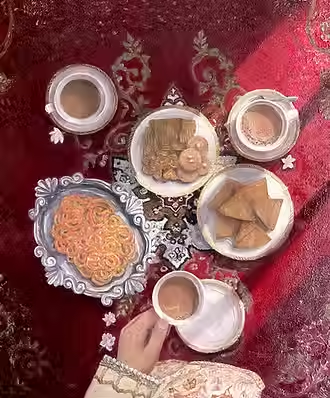
Quiet Rituals is a collection inspired by the small, everyday moments that quietly become lifelong memories.

The paintings explore the rituals many of us return to without thinking, a cup of tea shared with family, the comfort of familiar recipes, homemade desserts enjoyed together, and the simple act of gathering around food. Though ordinary in appearance, these moments often become the memories we carry with us most deeply.

Each work began with a real experience or photograph that I wanted to preserve beyond the fleeting nature of a single moment. Rather than documenting these scenes exactly as they were, I reimagined them through layered textures, warm colour palettes, and a sense of quiet atmosphere, allowing memory and emotion to shape the final image.

At its heart, Quiet Rituals is about finding significance in what is often overlooked. It is an invitation to slow down and recognise that some of life’s most meaningful experiences are found not in grand occasions, but in the familiar rituals of everyday life.

I hope these paintings encourage viewers to pause, reflect, and reconnect with memories of their own, moments of comfort, togetherness, and home that continue to live on long after they have passed.

Quiet Rituals

Ayesha Zafar

My work is an exploration of memory, emotion, and the quiet moments that shape our lives. Through textured oil and mixed-media paintings, I seek to preserve experiences that are often overlooked; shared meals, afternoon tea, familiar objects, cultural traditions, and places that quietly become part of who we are.

Rather than painting subjects for their appearance alone, I am interested in the stories they carry. A cup of tea, a homemade dessert, the warmth of gathering around a table, or the comfort found in everyday rituals can hold memories that last far longer than the moments themselves. These ordinary experiences become the starting point for my work, inviting viewers to reconnect with feelings of nostalgia, belonging, and reflection.

Texture plays a central role in my practice. I use layered paint and mixed media to create surfaces that encourage a slower way of looking, allowing each piece to feel tactile and immersive. The physical qualities of the paintings become part of the storytelling, echoing the depth and permanence of memory itself.

As my practice continues to grow, I hope to explore a range of interconnected themes including culture, literature, faith, nature, and personal history, all united by a shared intention: to preserve meaningful moments through paint. Whether inspired by everyday rituals, sacred narratives, or places that leave a lasting impression, my work aims to celebrate the beauty found in the experiences that quietly shape our lives.

Moments – States of Being is an exploration of the emotional landscapes that exist between movement and stillness. The Seen & Unseen. These paintings arise from quiet encounters with nature, where light, colour, atmosphere and memory become reflections of an inner state of mind. Each work captures not merely a place or a moment in time, but a feeling.
There are moments when life carries us forward with relentless motion and others when time seems to pause. It is within this delicate balance that my paintings find their voice. The works speak of softness and restraint, of silence and turbulence existing side by side. They invite the viewer to slow down and become aware of the subtle conversations that unfold between the self and the natural world.
Working in an impressionistic and representational language, forms simplify while preserving the emotional truth of the landscape. Intention is not to document nature as it appears but to evoke its atmosphere and quiet presence. The familiar landscapes become metaphors for contemplation, resilience and renewal.
This exhibition is an invitation into a space of reflection. Here, nature becomes more than a subject; it becomes a companion, a witness and a gentle reminder of our connection to something larger than ourselves. The exhibit celebrates the beauty of noticing, the comfort of silence and  nature's quiet abundance. Through these paintings, i hope the viewers discover echoes of their own inner journeys.

MOMENTS - States of Being

SHASWATI DEBNATH

As a visual artist I am continually inspired by the infinite forms, colours, textures, rhythms and patterns found in nature. Every landscape, weathered object, play of light presents an opportunity to observe, interpret and transform the ordinary into something enduring. My artistic practice is rooted in oil painting where the richness of colour, expressive brushwork and tactile quality of the medium allow me to explore both the visible world and the emotions it evokes.
Working in an impressionistic yet representational style, I seek to balance realism with painterly expression. Rather than reproducing a scene exactly as it appears, I aim to capture its atmosphere and essence. Light, colour harmony and composition become the language through which I communicate a sense of place, memory and quiet contemplation. I enjoy simplifying forms while preserving the subtle details that give a subject its unique character, allowing viewers the freedom to complete the narrative through their own experiences.
Always believe that art should invite reflection rather than complexity for its own sake. To me, the true power of painting lies in its ability to renew the mind through honest artistic expression. Whether working from direct observation or personal experiences, my paintings celebrate the beauty of everyday moments and the timeless relationship between humanity and nature. My work hopes to evoke sense of stillness, wonder & emotional connection and rediscover the poetry hidden.
Where Memory Resides explores the ways memory becomes embedded in people, places, objects, nature, and cultural symbols. Moving across portraiture, natural forms, architectural spaces, and symbolic imagery, the exhibition reflects on identity, belonging, heritage, and the emotional traces carried through lived experience.

The works consider memory not simply as something belonging to the past, but as a continuing presence that shapes how we understand ourselves, our surroundings, and our connections to culture and place. Each artwork holds a fragment of experience—personal in origin, yet connected to broader ideas of resilience, transformation, dignity, and shared human experience.

I would be grateful if you could add this statement to the exhibition page.

I would also like to ask whether No. 35 Gallery will be providing an official promotional poster or exhibition artwork for Where Memory Resides ahead of the launch on 10 September 2026. If one is available, I would appreciate receiving the official version so that I can use it when promoting the exhibition through my website and social media.

Where Memory Resides

Sunitha Gopal

My practice explores cultural memory, identity and belonging through realism and visual storytelling. Working across painting and drawing, I use light, objects, figures and symbolic details to connect personal memory with shared human experience.

Delicate Strength

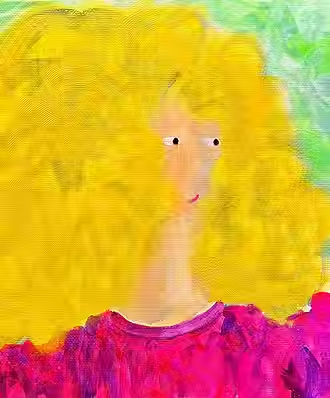
This series is about women and hair.

Lately, I have been drawn to the idea of a quiet feminine strength—a strength that makes space for vulnerability. To me, hair exists somewhere between protection and openness. We can hide behind it, retreating into our inner world, yet it also reveals who we are.

Hair becomes a symbol of memory, identity, and transformation. It reminds me of a lizard's tail: something that can be shed after loss or hardship, allowing us to grow into ourselves again.

The women in these works are ordinary women—alive, imperfect, and each carrying her own story.

I paint not only with brushes but also with hair combs. Alongside the paintings, I include photographs of the combs themselves, inviting viewers to see them not only as tools, but as symbolic objects that extend the story beyond the canvas.

For me, strength is not the absence of loss, but the ability to find yourself again.

Delicate Strength

Evgeniia Rodina (go6a)

Eugenia Rodina (go6a).

Born in 1981, Moscow.
Lives and works in Tbilisi (Georgia).

Explores themes of joy and the simplicity of life.
Media: painting, graphics, ceramics, and digital illustration.

Values: love, joy in everyday life, harmony in imperfection, sincerity and vulnerability as strength, uniqueness, emotions as an inner cosmos.


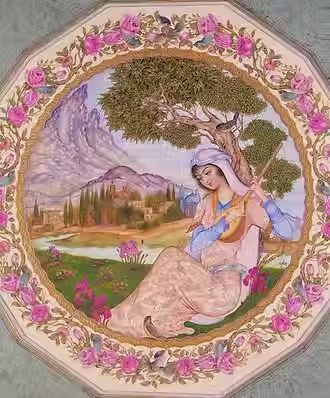
This exhibition is a journey between the past and the present, where the authentic elements of Iranian art are brought to life through the vision and emotions of a contemporary artist. The presented artworks reflect the connection between tradition, nature, and human experiences.

In this collection, familiar motifs from Persian miniature painting, flowers, and birds are reimagined in a new atmosphere, offering a different perspective on the hidden beauty of Iranian culture to a global audience.

This exhibition seeks to highlight the lasting and dynamic nature of traditional art; an art form that continues to inspire, remain alive, and create meaningful connections. Each artwork invites the viewer to discover the delicacy, emotions, and stories hidden within colors and lines.

Persian painting

Masoume Pourbasirat


Throughout my artistic journey, I have always sought to create a meaningful connection between the valuable heritage of Iranian art and my personal vision. For me, painting is a language through which emotions, memories, and the beauty inspired by my culture, nature, and homeland can be expressed.

My artworks are inspired by Persian miniature painting, floral and bird motifs, and the delicate elements of traditional Iranian art. Through my practice, I aim to present these precious elements with a renewed feeling and a personal perspective. Colors, lines, and details come together like poetic words, creating an atmosphere filled with serenity, delicacy, and imagination.

In each artwork, a dialogue emerges between the authentic roots of Iranian art and contemporary emotions; a dialogue that reflects beauty, hope, and the deep connection between humanity and nature. Each painting is a gentle story of love for art and respect for cultural heritage, beginning from my homeland and creating a sincere connection with audiences around the world.

Un sentido homenaje a la amistad, al compañerismo con el que tantos me acompañaron permanentemente hasta recibir el premio que hoy me otorgan.

Cuando Las Hojas Caen

María Claudia López Granados


Soy de la tierra donde todo es posible el mismo día, donde la luz de un Premio Nobel se ve ensombrecida por una matanza inmisericorde.
Soy una madre colombiana que sueña con que mis nietos amanezcan entre dulces colores de esperanza.

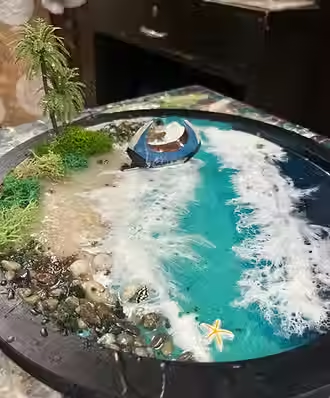
Every surface tells a story. Every layer holds a memory.

“This exhibition transforms resin, pigment, and natural materials into visual narratives that celebrate imperfection, resilience, and wonder. Inspired by coastlines, changing tides, and the quiet strength found in creation, each piece preserves a moment in time while inviting new interpretations. Rather than offering answers, these works encourage reflection, allowing every viewer to find their own meaning within the textures, movement, and light.

I believe art is more than decoration…it is an experience that reminds us to notice, to feel, and to see beauty where we least expect it.”

Where Stories Take Shape

Barrister Salsabil Afza Haque

I create mixed-media art that blends painting, resin, texture, and handcrafted elements. Inspired by faith, nature, and everyday beauty, my work transforms ordinary materials into meaningful pieces that invite reflection, warmth, and wonder.

In the “Duet” collection, which is about my parents and the dynamics of co-existing, I have traced my parents’ movements and everyday acts, creating a “harmony of the banal”. The harmony (or the lack of it) between my parents, mixed with domestic objects and space of the house, represents the shared space where gendered identities are formed and negotiated.
This collection consists of a series of drawings/studies made from life, done with pen & ink on paper, as well as a series of monochromatic paintings that developed later. For me, the minimal and monochromatic colour palette means a more direct and sincere way of self-expression, and a better representation of the “harmony of the banal”, where colour (or the lack of it) captures the essence of what is to be human.

Duet / Harmonies of the Banal

Nazanin Ghahramani

I am a London-based artist working across drawing, painting, printmaking, and digital fabrication at the intersection of art, ethnography, and sociology. My practice explores identity formation, domestic life, spatial politics, and the everyday acts through which identities are shaped, negotiated, and sometimes collide across private and public spaces. Drawing on my background in Fine Art at the University of Tehran, I use visual research, narrative, material experimentation, and spatial thinking to create works that move beyond representation and reflect on memory, gender, family, and human conditions.
As an artist, I am always looking for media that best suits my visual research and questions, encompassing traditional drawing and painting techniques as well as digital techniques such as photography and digital fabrication. My studies in Fine Art (University of Tehran) and Architecture (University of Westminster) have given me representational tools that go beyond mere representation; creating artworks that engages with its surrounding and reflects on human conditions, such as identity, gender and spatial politics.
In my works, I navigate my immediate surrounding, using visual ethnography to reflect on the self, memory and familial relations.

Dasein, meaning "Being" or "Being-there," is the term Martin Heidegger used to describe the human mode of existence in the world—a presence shaped through an inseparable relationship with the world, experience, and choice."Dasein  series proposes that meaning is not something given, but something created through perception, reflection, and the choices we make. It is an invitation to step beyond familiar patterns, embrace uncertainty, and recognize that our existence is continually shaped.

Dasein

Leily Rohani

Leily Rohani is an Iranian photographer and alumna of Alzahra University. She has completed specialized courses in photography and filmmaking at professional art institutes and is a member of the International Federation of Photographic Art (FIAP).

This exhibition celebrates the beauty of Persian miniature through poetic landscapes, birds, flowers, and timeless stories, inviting viewers into a world of harmony and imagination.

Whispers of the Persian Garden

Selina Pouria

Inspired by Persian miniature, I weave nature, poetry, and symbolism into timeless narratives, preserving cultural heritage through a contemporary artistic vision.

Persian painting, as traditional art, possesses unparalleled depth. This style depicts scenes of daily life and landscapes alongside mythological and poetic narratives which appeared in books and manuscripts. In this collection, by combining various Persian painting techniques and employing vibrant colors and forms born of my own emotions, I have sought to embark on a journey of inner exploration and connection with the outside world.

Beyond the Miniature: Whispers of Light & Imagination

Paria Sadat Lavasani

Paria Sadat Lavasani, after receiving her PhD of Molecular Medicine, began Iranian painting . Surrealist and expressionist art are her main favorite subjects, in which reality and dream merge or emotions are depicted.

Exhibition Statement

For me, woodcarving is more than a traditional craft or the technical practice of carving wood; it is a visual language through which I explore the relationship between humanity, nature, time, and cultural heritage. This body of work is rooted in the rich tradition of Persian woodcarving, yet it does not seek to reproduce the past. Instead, it reinterprets this centuries-old artistic legacy through a contemporary sculptural perspective.

Wood—with its unique grain, texture,

Whispers of wood

Maryam Byrami

Artist Statement

Woodcarving is, for me, a continuation of a dialogue that has existed for centuries between the artist, wood, and the rich cultural heritage of Iran. My work is deeply rooted in the traditional art of Persian woodcarving, a practice

These handmade clay vases play with solid shapes and open spaces. The clay is shaped and pierced with cut out patterns drawn from Islamic geometric design and Moorish window screens. Light shines through the carved holes, showing hints of underneath. The angular shapes meet delicate, geometric patterns and floral designs. The rough clay surface feels earthy and handmade, while the open, carved parts let light and shadow move through the piece.

The scared ground of makli

Muskaan Irshad

Carved stoneware pieces shaped by the funerary architecture of Makli. Pierced surfaces different and color and with stony texture, echoing weathered tombs and glazed tilework exploring the vase as threshold between solid form with lights and shadows.

The exhibition explores the space between the familiar and the unfamiliar, where everyday food and objects of the table move beyond their ordinary identities. Through painting, these forms become organic and ambiguous presences, inviting a renewed encounter with the everyday and encouraging us to look again at what we thought we already knew.

The Familiar, Transformed

Marzieh Ramazanpour

What is familiar gradually slips away from its name. Everyday food objects leave behind their ordinary roles, becoming ambiguous, living forms that seem to take on a life of their own, inviting us to look again.

One does not have to climb volcanoes to see an explosion of colour. This universe lies right on our own front doors. The works presented here were photographed in European gardens – without removing the flowers from their environment. This unusual perspective was made possible by strong magnification, reducing the depth of field to just a few millimetres. This creates a tension between sculpted and abstract, where small details transform into almost cosmic landscapes of colour and form.

Explosion of colours

Michael Stierle

I am eager to move across artistic genres like abstract, macro or minimalism to documentary photography. Independently of the genre, one common feature of my photos is their simple, even minimalist composition, focusing on the essential.

The exhibition "Perception" invites you to see the world not just with physical eyes, but to look inward. Nothing here is static: colors vibrate, motifs breathe. Through a mixed-media acrylic technique using real materials, the works emerge three-dimensionally from the canvas into the space. Art is only completed by the viewer – through their imagination between the real story and the perception of the felt emotions behind it.

Perception (Wahrnehmung)

Thea Elvont

My art is a dialogue between the visible and the felt. Through 3D textures, I let deep emotions flow freely onto the canvas. The works come alive, step into the space, and connect from soul to soul in a state of perception.

Artist Sabreen Al-Majed presents an artistic experience rooted in the spirit of the horse as a symbol of power, freedom, and momentum, taking its hooves as a visual and expressive axis through which she explores movement, rhythm, and inner emotion. Moving away from realistic documentation, she leans toward the emotional trace left by the horse's movement in memory and feeling, transforming the hooves into pulsing lines and color masses carrying the energy of release and collision. Through a free

Hoof Dream

Sabreen Almajed

Sabereen Al-Majed is a Saudi visual artist from Al-Ahsa, a graduate of King Faisal University. She has earned more than ten university awards and twelve local and international awards. She adopts abstraction, drawing inspiration from horse hooves.

This solo exhibition reimagines the cosmos not as an untamed frontier, but as a highly structured grid. The ready-made block toys serve as a dual symbol: a monument to human curiosity and a critique of our consumerist footprint. By embedding NFC chips directly into the canvas, the body of work translates data into sonification—forcing us to confront whether we are true explorers of the universe or merely loops running within a grand design.

A Glitch In The Orbit

Dongpu Ling

Dongpu Ling is an intermedia artist and educator working across sculpture, interactive installation, performance, and generative audio/video. She creates immersive environments that activate public spaces.

My work looks at how bodies are seen before people are understood. Through photography, moving image, textiles, installation and digital manipulation, I work with communities shaped by scars, labour, discipline, violence and belonging. I use close detail, repetition and abstraction to slow the gaze and ask what it means to look beyond the first visible mark.

Before you see the scar

Monica Dhaka

Monica Dhaka is a visual artists questioning how bodies are represented, seen, and remembered. She does not use photography only as documentation, but as a material, collaborative, and reflective way to explore identity, recognition, and belonging.

Fractured Vision explores the soul split by conflict. Using gypsum and shattered mirrors, it shows how reality fragments our identity. The artwork is incomplete without the viewer; standing before it, your reflection breaks into shards, making you part of the piece. Yet, this is not about despair. Each broken mirror shard retains the power to catch and scatter light, balancing deep brokenness with enduring hope. It proves that from our deepest fractures, new light and healing emerge.

Fractured Vision

Balqees Aesar Al jaramani

I view art as a safe haven to express our souls honestly. Evolving from foundational clay to shattered mirrors and threads, my practice captures human resilience, seeking absolute truth and a peaceful commentary on surrounding realities.

CITIES TELL ME STORIES explores the emotional landscape of contemporary cities through abstraction. Inspired by urban rhythm, light, movement, and fleeting moments, the paintings transform architecture into memory and atmosphere. Palette knife gestures and rich impasto dissolve the physical city into expressive forms, inviting personal interpretation. Each canvas reveals the unseen conversations of urban life, where every city becomes a story of shared human experience.

CITIES TELL ME STORIES

Anand Swaroop Manchiraju

Creation unfolds through exploration, patience, and quiet discovery, where process and outcome become inseparable. Within this evolving journey, art emerges as a space of freedom, reflection, and authentic expression.

Landscape is approached here as a space of emotional and psychological experience rather than physical description. Familiar elements dissolve into imagined environments where memory, presence, and absence coexist. Moving between the domestic and the natural, the works invite reflection on how places are remembered, transformed, and carried within us, revealing the shifting relationship between our inner world and the spaces we inhabit.

Utopia

Eri Papadopoulou

In this body of work, I explore place, memory, and identity. Through real and imagined landscapes, I create psychological landscapes that blur reality and memory, exploring belonging, absence, and connection to the surrounding world.

A Life in Circles is a series of four self-portraits that traces over a decade of living with endometriosis, adenomyosis, endometrial hyperplasia, and PCOS. Created following my hysterectomy and excision surgery, the third surgery I underwent in four years, at the age of twenty-nine. The works reflect on the physical and emotional realities of chronic illness and the long journey towards being believed.

Drawing on domestic spaces, embroidered thorned vines, circles, drains, and fragments of memory, the series explores pain, repetition, loss, resilience, and survival. These recurring motifs mirror the cyclical nature of chronic illness, where symptoms return, bodies are repeatedly scrutinised, and recovery is rarely linear. The home becomes both a place of refuge and confinement, while embroidery serves as a slow, repetitive act of recording experiences that often remain invisible.

Each self-portrait marks a distinct chapter. The First Flood/21 revisits the confusion and fear of the first symptoms and the beginning of years without answers. Morning After Morning/26 reflects the recurrence of pain after surgery and the quiet isolation of living with an invisible illness. The Breaking Point/28 captures the emotional and physical exhaustion that preceded my decision to undergo a hysterectomy, as the body became increasingly consumed by pain. What Remains/29 brings these fragments together, acknowledging the scars that remain while reclaiming them as evidence of endurance rather than defeat.

This body of work is both deeply personal and profoundly collective. It speaks to the countless people whose pain has been minimised, dismissed, or misunderstood. A Life in Circles is not only an archive of illness but also a testament to survival, asking what evidence is required to prove suffering and what becomes possible when lived experience is finally recognised. Through these works, I invite viewers to reflect on the hidden realities of chronic illness, the politics of visibility, and the quiet resilience of bodies that continue despite everything.

A Life in Circles

Kavya Sharma

My practice explores memory, identity, and lived experience through textiles, drawing, and installation. Using repetitive processes and material storytelling, I investigate themes of care, resilience, and transformation, creating spaces for reflection on the relationships between body, place, and the narratives that shape our everyday lives.

This exhibition approaches stories never told fully: a fractured trace, a city whispering from afar, a memory caught between what was lost and what survived. Through layered light, texture, and silence, I reimagine what is no longer visible, offering each fragment the warmth and quiet presence it deserves.

Memory of Light

Esraa Alhariri

I work with what hides behind the trace: a shadow of a story, a vanished touch, a memory that breathes despite absence. I gather what slips through time and reshape it, giving unfinished stories warmth and space to return.

While making these faces I don’t look at any faces, which is why these faces look like these faces.

Drawing inspiration from my memory. (drawn to the idea) withholding any interaction with images so that they don't influence my view on how the camera sees the faces.
I want it to come from my retained memory. A memory could be flawed, but they also let me remember the faces of what I witnessed, rather than the perfection of the imaged faces.

Which is why, While making these faces, I don’t look at any faces, which is why these faces look like these faces

While the person is smiling at me, because I notice the bridge of a strong nose, the fold of the skin on the bridge is what really tells me that the person is happy around me, not the smile, only when the fold comes through because the person is grinning so wide this is to preserve that.

They are all being drawn from the memory, like being drawn from the soul. Which is what might remind you of someone you might know.

Which is why, while making these faces…. I don’t look at any faces, which is why these faces look like these faces.

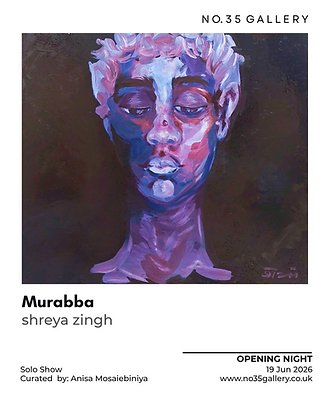
murabba

shreya zingh

I paint portraits, landscapes and architectural extravagances solely from memory, using walnut oil and archival oil paints on cotton and MDF. This is for peeps who want to enter my mind.
Every face is painted, feel free to find someone you once knew.

This photograph explores the fragile presence of peace within darkness and uncertainty. Through intentional motion blur, low light, and layered blue tones, I aimed to create a dreamlike atmosphere that reflects emotional stillness hidden within chaos. The distorted imagery mirrors the fleeting nature of inner peace—never fully clear, yet deeply felt. Rather than documenting reality, the piece captures an emotional state suspended between silence, movement, and reflection.

Peace within Chaos

Palistha Shrestha

My work reimagines reality through blur, motion, and light. Drawing from personal perception and cultural narratives, I create dreamlike imagery that explores memory, emotion, and the beauty found beyond perfect clarity.

My work explores internal states of restriction, control, and psychological pressure, often reflecting broader social and political conditions. In The Rope, I focus on the tension between burden and resilience, portraying the ways in which individuals navigate forces that constrain them—physically, emotionally, or socially. I am interested in moments where the body or mind appears contained, and how subtle visual elements can evoke the possibility of release, resistance, or quiet endurance.

The Rope

Rasha Abo Zedan

Working primarily with digital media and a conceptual visual language, I rely on careful composition, lighting, and form to convey these psychological and emotional narratives. Each piece invites the viewer to engage with both the heaviness of restriction and the quiet strength of persistence.

My work is inspired by everyday feelings that we all experience. I mostly use oil paints to create my paintings, trying to show real expressions and moments that can connect with people. Through my art, I want to make viewers feel something natural and genuine, and remind them of the emotions we sometimes overlook in daily life.

Echoes of The Inner Self

Hadia Rizwan

I’m Hadia Rizwan, a Pakistani Fine Arts graduate from the University of Gujrat in 2025, where I completed my BFA with distinction. My primary medium is oil painting, and I focus on creating realistic artworks that reflect the emotions and quiet beauty found in everyday life.

My creative process is rooted in observation, intuition, and the free movement of color. Color in my paintings is not merely decorative; it carries energy, emotion, and meaning. A fluid balance forms between personal narrative, symbolism, and imagination, allowing each work to invite multiple interpretations.
 
I do not believe in limiting myself to a single subject or fixed mode of expression. The diversity of themes is a natural part of my ongoing exploration in painting; a path in which the image becomes my primary language for thinking and inner expression.

Not Just a Cow

Parastou Azizi

Painting is a safe space for me to think through images.
My works are conceptual and take shape as series, each centered around a different subject. Each series emerges as a response to a lived experience, an inner question, or an intuitive encounter with the world around me.

Subscribe to Our Newsletter

Solar House
High street
London
England
United Kingdom

Tel: +44 7769994001

© 2025 by no.35 Art Gallery. 

bottom of page