
Field Review | Artist Interview Series
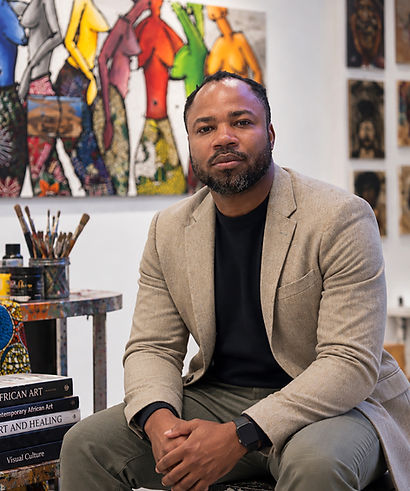
In conversation with
Godspower Ignatus Okoro
Godspower Okoro is a Nigerian multidisciplinary visual artist based in Scotland, working across painting, drawing, printmaking, photography, sculpture and mixed media.
He has practised professionally since 2011, following his graduation from Yaba College of Technology, Lagos. He holds an MA in Fine Art with Distinction from Gray’s School of Art, Robert Gordon University, Aberdeen. Born and raised in Lagos and originally from Imo State, Nigeria, Okoro’s work is informed by his Igbo heritage and Yoruba upbringing.
He has exhibited in Nigeria, the UK and internationally, including Spain and Switzerland. His work has received institutional recognition, including the RGU Arts and Heritage Purchase Award, with Passages of the Unseen acquired for the Robert Gordon University collection.
From:
United Kingdom
Artist Statement
Godspower Okoro’s practice explores identity, memory, belonging and the relationship between people, culture and place. Drawing from his heritage, upbringing, indigenous knowledge, mythology and lived experience, he combines abstraction, symbolism and figurative elements to examine how cultural memories and histories are inherited, preserved and transformed.
Okoro works across painting, drawing, printmaking, photography, sculpture and mixed media, using layering, fragmentation and material experimentation to create works that invite contemplation and multiple interpretations. His practice also responds to social and environmental concerns, particularly the changing relationship with nature and the traces left behind.
He is interested in the space between the visible and unseen, memory and forgetting, personal experience and collective history. Through his work, he explores how identity evolves across places and generations, bringing African cultural knowledge into dialogue with contemporary experience.
Tell us about yourself and your artistic background.
My name is Godspower Okoro, a Nigerian multidisciplinary visual artist currently based in Scotland. Raised in Lagos, Nigeria. My artistic journey began formally at Yaba College of Technology, Lagos, where I studied Fine Art and graduated in 2011. Since then, I have practised professionally, working across painting, drawing, printmaking, photography, sculpture and mixed media.
I later moved to Scotland to pursue an MA in Fine Art at Gray’s School of Art, Robert Gordon University, Aberdeen, graduating with Distinction in 2025. My experiences of growing up in Lagos, my Igbo heritage and my continuing journey between Nigeria and Scotland have all contributed significantly to the way I see and make art.

How would you describe your artistic practice?
I would describe my practice as multidisciplinary, experimental and deeply connected to memory and cultural experience. I move between different media depending on what the idea requires rather than restricting myself to one particular form.
My work often brings together abstraction, symbolism and figurative elements. I am interested in layering materials, images and meanings to create works that can be experienced visually but also invite deeper reflection.
What themes or ideas are most important in your work?
Identity, memory, belonging, spirituality, cultural heritage and our relationship with nature are central to my practice.
My dual cultural experience. I draw from both Yoruba and Igbo knowledge, traditions, mythology and lived experiences. I am particularly interested in how cultural memories are carried from one generation to another and how they change when we move between different places and environments.
I also explore the relationship between the visible and the unseen, what we remember, what we forget and what remains with us even when it is no longer physically present.

What inspires your creative process?
My inspiration often comes from observation, memory, personal experiences, cultural narratives and my environment. Sometimes an image, object, conversation, historical reference or memory can become the starting point for a work.
I do not always begin with a completely defined outcome. I allow the process to develop through experimentation with materials, layering, mark-making and composition. Sometimes the material itself suggests the next direction. That element of discovery is very important to me.
Can you tell us about a recent artwork or project?
One significant recent body of work is Passages of the Unseen. The project explores memory, transition, spirituality and the unseen aspects of human experience. I was interested in the idea of movement between different states, what we carry with us, what we leave behind and what continues to exist beyond physical presence.
The work developed through a process of layering and fragmentation, allowing different visual elements to coexist rather than presenting a single, fixed narrative. The work was particularly meaningful to me because it brought together personal, cultural and universal ideas. It was acquired for the Robert Gordon University Arts and Heritage collection, which was an important milestone in my practice.
What challenges have influenced your development as an artist?
This has to be sustaining an artistic practice while navigating different environments and responsibilities. Working as an artist requires resilience, especially when opportunities, resources and visibility are not always consistent.
Moving to Scotland also placed me in a new cultural and artistic environment. It challenged me to reconsider how my work is understood outside the context in which my ideas originally developed. Rather than seeing this as a limitation, I have used it as an opportunity to expand my practice and examine my identity from a different perspective.
What role does art play in your life today?
Art is more than a profession for me; it is a way of understanding the world and my place within it. It gives me a language through which I can explore experiences and ideas that are sometimes difficult to express verbally.
It also allows me to connect different parts of my identity and to preserve, question and reinterpret cultural knowledge. Today, art is both a personal journey and a way of communicating with wider audiences.
What are you currently working on?
I am currently developing new works that continue my exploration of memory, identity, cultural heritage and environmental concerns. I am particularly interested in how these ideas change when viewed from the perspective of living between different cultural and geographical environments.
I am also continuing to experiment with mixed media and different processes, allowing materials and fragments of imagery to interact in unexpected ways. My current direction is about expanding the visual language of my practice while remaining connected to the cultural and personal questions that have always informed my work.
What are your future goals as an artist?
My goal is to continue developing a distinctive and meaningful artistic practice that engages audiences in Scotland and internationally. I want to deepen my research into cultural memory, identity, indigenous knowledge and environmental concerns, while continuing to experiment with materials and forms.
I also hope to build stronger relationships with galleries, museums, curators and other professional artists, and to participate in exhibitions and collaborative projects that create meaningful conversations across cultures. As my practice develops, I would like my work to enter more public and institutional collections and to contribute to conversations about African contemporary art within the wider international art landscape.
Ultimately, I want to continue growing as an artist while creating work that is honest to my experiences, culturally grounded and capable of connecting with people wider audience.
Where can readers follow your work?
Readers can follow my artistic journey and see my latest works and exhibitions on Instagram at @emperorgoddy. I also share updates about my exhibitions, projects and ongoing studio practice there.
