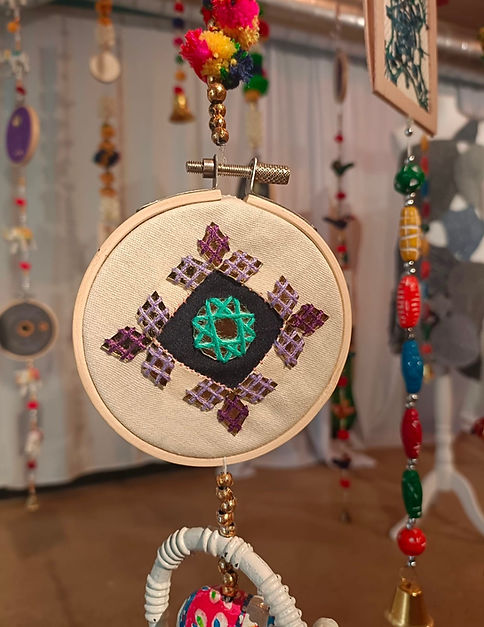
Field Review | Artist Interview Series
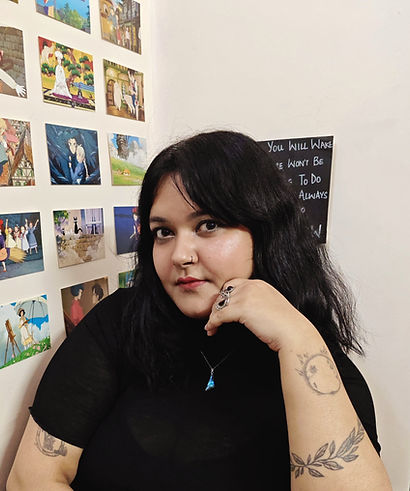
In conversation with
Kavya Sharma
Kavya Sharma is a craft and sustainability designer and artist, textile practitioner, researcher, and community arts facilitator from Meerut, India. Holding a Bachelor's degree in Craft and Textile Design from the Indian Institute of Crafts and Design and a Master's degree in Sustainable Design from Kingston University London, her practice explores hands-on making, identity, migration, cultural heritage, care, and sustainability through textiles, drawing, printmaking, and socially engaged art.
Working between studio practice and community collaboration, she creates projects that combine traditional craft knowledge with contemporary artistic approaches. Her work has been developed through exhibitions, workshops, and public engagement projects across India and the UK, including collaborations with the Crafts Council UK, Stanley Picker Gallery, London, Ariadne's Thread, Global Threads Kingston, Coven Community, Kingston Libraries, and community organisations. Through research, storytelling, and material experimentation, she investigates how objects, textiles, and collective making can preserve histories, strengthen communities, and create meaningful connections across cultures and generations.
She explores arts and crafts as a form of self-expression, communication, and story-telling for the people. She also works with adults with dementia and learning disabilities facilitating a variety of art, craft, music, and play-based activities.
From:
India
Artist Statement
My work sits at the intersection of contemporary art, textiles, and socially engaged practice. Through embroidery, drawing, installation, and participatory projects, I explore how materials can communicate experiences that are often difficult to express through words alone. I am interested in making work that encourages reflection, conversation, and connection.
My background in craft and sustainable design has shaped an approach that values process as much as the finished work. Hand stitching and other repetitive techniques are central to my practice, not only for their visual qualities but for the time, care, and attention they embody. I work with both traditional textile methods and reclaimed materials, considering how making can preserve knowledge, question contemporary relationships with material culture, and offer alternative ways of understanding the world.
Across my work, I explore themes of identity, care, resilience, and belonging. Personal experience often provides the starting point, but my aim is to create work that resonates beyond autobiography and opens space for shared reflection. I am particularly interested in the ways individual stories intersect with broader social, cultural, and environmental questions.
Whether creating independent studio work or facilitating collaborative projects, I see art as a means of building dialogue and community. I hope my work invites people to look more closely, engage thoughtfully with material, and recognise the value of slow, intentional making in an increasingly fast-paced world.
Tell us about yourself and your artistic background.
I grew up in Meerut, India, and from an early age I was always drawn to making things. As a rather shy and introverted child, I often found comfort in quiet, creative activities, drawing, stitching, crafting, and experimenting with different materials. Making became a way for me to express myself, process experiences, and connect with the world around me, and it continues to shape my practice today.
This early fascination with craft and materiality led me to study Craft and Textile Design at the Indian Institute of Craft and Design in Jaipur. During my studies, I became increasingly interested in the social, cultural, and environmental dimensions of craft, particularly its ability to preserve stories, communicate lived experiences, and bring people together.
This interest eventually brought me to London, where I completed a Master's in Sustainable Design at Kingston University. Living and working across India and the UK has significantly influenced my perspective, encouraging me to explore themes of memory, migration, identity, and belonging within both personal and collective contexts.
Alongside my studio practice, I have worked extensively as an arts facilitator and community practitioner, collaborating with galleries, cultural organisations, and diverse communities. These experiences have reinforced my belief that art can create meaningful connections, preserve cultural knowledge, and create spaces for dialogue and exchange. Today, my practice sits between research, material exploration, and socially engaged approaches, often using textiles and storytelling to explore lived experiences and shared histories.

How would you describe your artistic practice?
My practice is intuitive and process-driven. I often begin with a personal experience, memory, object, or question that I want to understand more deeply. From there, I undertake periods of research, collecting stories, photographs, archival material, found objects, and textile fragments that help me build connections between the personal and the wider social or historical context.
I work across textiles, drawing, printmaking, installation, and participatory methods, selecting materials and processes according to the needs of each project. I am particularly drawn to slow, repetitive processes such as stitching, layering, and hand-making, as they allow space for reflection and embody ideas of care, repair, and resilience.
Experimentation is an important part of my practice. I enjoy allowing materials to guide the work, embracing unexpected outcomes and the stories that emerge through the making process. Whether creating studio-based work or collaborative projects, I am interested in creating spaces for reflection, conversation, and emotional connection.
Community participation is central to my practice, and I see art as a way of creating meaningful exchanges between people, places, and experiences.
What themes or ideas are most important in your work?
At the heart of my work is an interest in how people carry memories, within their bodies, through objects, and across generations. I am fascinated by the ways in which personal histories become intertwined with larger cultural and social narratives, and how art can make these often invisible experiences visible.
I frequently explore ideas surrounding memory, embodiment, care, loss, resilience, and belonging. Much of my work asks how identities are shaped by lived experience, migration, family histories, and cultural inheritance. I am also interested in the emotional and symbolic significance of textiles and everyday materials, particularly their ability to hold traces of use, labour, and affection.
Ultimately, my work seeks to explore what it means to belong, to a place, a community, a body, or a history, and how acts of making can help us preserve, question, and reimagine these relationships.
Women's experiences are also an important aspect of my work, particularly through work that explores health, the body, and lived experience.
Sustainability and the value of traditional knowledge further shape my approach, leading me to investigate how craft practices can contribute to contemporary conversations around community, wellbeing, and environmental responsibility.

What inspires your creative process?
Inspiration often comes from small, everyday encounters, personal experiences, family stories, conversations, inherited objects, old photographs, textiles, places, and moments that might otherwise go unnoticed. I am particularly interested in the emotional histories embedded within ordinary materials and how these can reveal larger narratives about identity, memory, and belonging.
Research plays an important role in my creative process. I spend a lot of time reading, visiting archives and museums, collecting visual references, and speaking with people about their experiences. These encounters frequently become starting points for new work. I am especially inspired by traditional craft practices and the knowledge that is passed between generations through making.
Personal experiences also profoundly shape my work. Whether reflecting on migration, health, relationships, or cultural heritage, I often begin with questions arising from my own lived experience and then explore how these resonate more broadly. Ultimately, I am inspired by the possibility that art can transform personal stories into shared experiences, creating connections between individuals, communities, and histories.
Can you tell us about a recent artwork or project?
One of my most recent bodies of artwork is A Life in Circles, a series of four self-portraits developed following a hysterectomy and excision surgery, my third surgery in four years at the age of twenty-nine. The work draws from more than a decade of living with endometriosis, adenomyosis, endometrial hyperplasia, and PCOS.
Using circular forms as both a visual and symbolic structure, the series reflects on cycles of pain, treatment, recovery, loss, resilience, and transformation. The works explore the relationship between the body and memory, examining how chronic illness can shape identity while simultaneously revealing strength and endurance.
Through layered mark-making and symbolic imagery, I sought to create a visual language capable of communicating experiences that are often invisible or difficult to articulate. While deeply personal, the work also addresses broader conversations around women's health, medical narratives, and the social silence that frequently surrounds these experiences.
Each self-portrait marks a distinct chapter. The First Flood/21 revisits the confusion and fear of the first symptoms and the beginning of years without answers. Morning After Morning/26 reflects the recurrence of pain after surgery and the quiet isolation of living with an invisible illness. The Breaking Point/28 captures the emotional and physical exhaustion that preceded my decision to undergo a hysterectomy, as the body became increasingly consumed by pain. What Remains/29 brings these fragments together, acknowledging the scars that remain while reclaiming them as evidence of endurance rather than defeat.
A Life in Circles represents an important shift in my work, bringing together autobiographical storytelling, research, and material exploration to examine the body as a site of memory, vulnerability, and resilience.
A recent project that has been particularly meaningful is Kanthas of Friendship, a large-scale community textile initiative delivered in London through Ariadne's Thread and Kingston 2025. Over the course of a year, I facilitated more than forty workshops involving over one hundred participants from diverse cultural backgrounds. Using the traditional Kantha embroidery technique alongside textile recycling, block printing, and storytelling, participants transformed personal fabrics and discarded textiles into artworks carrying memories, cultural heritage, and lived experiences culminating in an exhibition.
What challenges have influenced your development as an artist?
Like many artists, my practice has been shaped by periods of uncertainty, transition, and change. Moving between India and the UK, for instance, prompted me to think more deeply about questions of identity, belonging, and cultural memory. Navigating different cultural contexts encouraged me to reflect on what we carry with us, through memories, traditions, objects, and stories, and these reflections continue to inform my work.
Living with chronic illness has also profoundly influenced my development as an artist. Over the years, experiences of Endometriosis, Adenomyosis, multiple surgeries, and long periods of recovery have shaped both my perspective and my practice. These experiences led me to reflect on the body as a site of vulnerability, pain, and resilience, while also encouraging me to engage more openly with personal narratives in my work. Projects such as A Life in Circles emerged directly from this process, allowing me to explore experiences that are often invisible or difficult to articulate.
Another important challenge has been balancing studio practice with community engagement and freelance work. While this can be demanding, working with diverse communities has expanded my understanding of art as a collaborative and relational process, continually challenging me to listen, adapt, and rethink how creative practice can foster connection and dialogue.
Rather than seeing challenges as obstacles, I view them as experiences that have deepened my understanding of myself, my practice, and the kinds of conversations I want my work to create.
What role does art play in your life today?
Art remains the way I make sense of the world and my experiences within it. As someone who was quite shy and introverted growing up, making has always been a language through which I could express thoughts and emotions that I often found difficult to articulate verbally. Although my practice has evolved over the years, that impulse to understand, reflect, and communicate through making remains central to who I am.
Today, art is both a personal necessity and a means of connection. It provides a space for reflection, research, and experimentation, allowing me to engage with questions that matter deeply to me while also creating opportunities for dialogue with others. Through my work, I hope to make visible stories and experiences that are often overlooked, whether they are related to women's health, migration, or cultural heritage.
Art also continually reminds me of the importance of care, community, and shared experience. Whether I am working alone in the studio or collaboratively with others, I see creative practice as a way of fostering empathy, preserving stories, and building meaningful connections between people, histories, and places.
What are you currently working on?
I am currently developing a new body of work that reflects on my life after surgery and explores experiences of loss, grief, healing, and transformation. Following a hysterectomy and several years of living with chronic illness, I have been thinking deeply about how the body holds memory and how significant physical changes can reshape one's sense of self, identity, and future.
Through textiles, and mixed-media processes, I am exploring the emotional complexities of grief, not only grief associated with illness and the body, but also the quieter forms of loss that accompany major life transitions. I am interested in how making can become a way of processing these experiences, creating space for reflection while giving form to emotions that can often be difficult to articulate.
Alongside this, I continue to investigate the relationship between personal narratives and wider cultural understandings of care, femininity, resilience, and embodiment. Ultimately, I hope this evolving body of work will open up conversations around experiences that are often deeply personal yet widely shared.
Through future residencies, exhibitions, and collaborative projects, I hope to expand my work and research internationally and continue building connections between craft traditions, contemporary art, and community engagement.
What are your future goals as an artist?
I hope to continue pushing my practice beyond the boundaries of traditional textile art, developing larger and more immersive works that bring together material experimentation, research, storytelling, and participatory elements. I am particularly interested in expanding my practice through international residencies and cross-cultural collaborations, allowing new places, people, and histories to inform and challenge my work.
Above all, I want to continue creating work that is both deeply personal and socially resonant, work that asks difficult questions, fosters meaningful connections, and gives visibility to experiences that are often overlooked.
Where can readers follow your work?
The best place to follow my work is on Instagram, where I regularly share updates on new work, exhibitions, research, and projects in progress. I enjoy using the platform as a space to document both finished pieces and the processes behind them, offering insights into the ideas, materials, and stories that shape my work.