
Field Review | Artist Interview Series

In conversation with
Małgorzata Gorzelewska-Namiota
Born in 1984. She lives and works in Lublin, Poland. In 2024, the Discipline Council of the Academy of Fine Arts in Warsaw awarded her the postdoctoral degree in the field of fine arts and conservation of works of art for her habilitation project “Is an Artist Allowed to Be
a Mother?”. She is employed as a university professor at the Faculty of Arts of Maria Curie-Skłodowska University, in the Department of Intermedia. She has participated in over 120 group exhibitions in Poland and abroad (Malaysia, Ukraine, Germany, Belgium, Bulgaria, North Macedonia, China, Hungary, Romania). She has organized 15 solo exhibitions. She is
a laureate of numerous awards and distinctions. She paints, creates objects and installations. Her works are marked by a strong personal narrative. She explores themes related to motherhood, the influence of childhood on the formation of human personality,
and intergenerational heritage.
From:
Poland
Artist Statement
Her children define her time and space. Living in the balance between constant caregiving and her intense need to create, she finds endless inspiration in being a parent. Motherhood brings out every possible emotion in her—blissful joy, the heavy weight of responsibility, and the frustration of helpless moments. Social media sells the illusion of the perfect mother, but she openly admits to her mistakes and imperfections. Through it all, her unconditional love remains untouched. She bases her creations on her personal life, but her message belongs to everyone. She looks back at her own childhood to see how it still shapes her adult self. She actively challenges the traditional archetype of the Polish Mother, showing life with children exactly as it is—routine, exhaustion, and all.
Tell us about yourself and your artistic background.
My formal education began at the Faculty of Arts of Maria Curie-Skłodowska University (UMCS) in Lublin, where I earned my MFA in printmaking in 2008. Expanding my practice toward painting and personal archeology, I pursued my doctoral research at the Academy of Fine Arts in Warsaw, defending my PhD project, “Slices of Memories. Forms of Recording the Past,” in 2014. While my early work was rooted in graphic techniques, my artistic voice naturally evolved into a dialogue with space and memory. Over the last decade, I transitioned from traditional painting to mixed-media, object-making, and experimental installations. This evolution allowed me to transform domestic routines and mundane acts into profound visual stories, culminating in my 2024 postdoctoral degree (habilitation) for the project “Is an Artist Allowed to Be a Mother?”. Today, this bridge between classical craftsmanship and modern intermedia defines my role as a university professor at UMCS.

How would you describe your artistic practice?
My artistic practice is driven by a vulnerable, personal narrative that explores the raw realities of motherhood, personal archeology, and intergenerational heritage. Bridging classical painting with mixed-media, object-making, and experimental installations, I transform mundane domestic routines into profound visual stories about space and memory.
What themes or ideas are most important in your work?
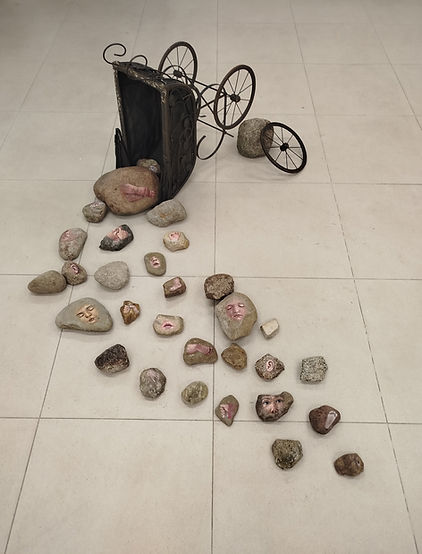
The core of my work revolves around three primary themes: Demystifying Motherhood, The Plight of Harmed Children, and Memory & Childhood. Through these lenses, I bring the hidden complexities of the private domestic sphere, social vulnerability, and past traumas into the artistic and academic space.
What inspires your creative process?
My creative process is profoundly inspired by my children, my motherhood, and the examination of personal traumas. The daily reality of raising children—the balance between unconditional love and the exhausting routine—serves as the primary catalyst for my work, allowing me to honestly explore the unfiltered experience of being a mother. Concurrently, my process is driven by an exploration of my own past. By confronting personal traumas and the long-term impact of childhood, I am inspired to create art that transforms these private, vulnerable memories into a universal visual narrative.
Can you tell us about a recent artwork or project?
"Mother" is a painting from the series Hidden, depicting a young girl on her mother’s lap, where the maternal figure is covered by translucent tulle attached directly to the canvas. The artwork references 19th and early 20th-century "hidden mother photography." Due to long camera exposure times, photographers kept restless children still by placing them on their mothers' laps, while draping the mothers in fabrics to erase them from the portrait. By using physical tulle, the painting serves as a metaphor for the social erasure of women, showing how a mother’s identity and presence are systematically rendered invisible, even as she serves as the vital support system for her child
What challenges have influenced your development as an artist?
Being suspended between constant caregiving and an irresistible, urgent need to create forced me to completely re-evaluate my artistic practice. Rather than allowing these limitations to silence my voice, I transformed the exhaustion, routine, and constraints of motherhood into my primary source of inspiration.
What role does art play in your life today?
It is much more than a profession or an academic discipline—it is an absolute necessity and the motor that keeps me moving forward. Even during the most challenging times, when childcare and daily routines left me with almost no time or space, art remained my essential outlet. It is how I process my emotions, confront my past, and make sense of the world around me. Today, whether I am creating in my studio or teaching the next generation of artists at the university, art is the core constant that defines who I am.
What are you currently working on?
I am currently working on a painting series titled Hidden, which addresses the systemic marginalization and perceived insignificance of women in society. This body of work consists of female portraits on canvas, which I intentionally cover with various semi-transparent materials, such as tulle or netting. Visually, these delicate layers partially obscure the subjects, acting as a metaphor for how women's identities, voices, and emotional labors are often veiled or rendered invisible by cultural expectations.
What are your future goals as an artist?
My primary goal for the future is to expand my reach to international audiences and share my art with a broader, global community. While I have already participated in over 120 group exhibitions worldwide, I want to establish deeper connections abroad through international solo exhibitions, residencies, and collaborative projects.
Where can readers follow your work?
You can follow my work and stay updated on my latest exhibitions through my official channels:
Instagram: [@gorzelewskanamiota_art]
Facebook: [https://www.facebook.com/gorzelewskanamiota]
University Profile: [https://www.umcs.pl/pl/addres-book-employee,821,pl.html]
Follow
Małgorzata Gorzelewska-Namiota
