
Field Review | Artist Interview Series

In conversation with
Veronika Michalow
Veronika Michalow is an independent professional artist based in Germany. Working primarily in acrylic and oil, she has developed a distinctive visual language she describes as Atmospheric Vintage Realism with cinematic lighting. Her practice brings together realism, narrative imagery, symbolism and atmospheric storytelling across a growing range of thematic collections. Rather than being defined by a single subject, her work is united by mood, dramatic light, spatial depth and a strong sense of character and story. Each painting is conceived as a unique original composition, created to build its own world and emotional atmosphere.
From:
Germany
Artist Statement
My artistic practice is centred on atmosphere, cinematic light and visual storytelling. Through acrylic and oil painting, I create scenes that combine realism with a sense of memory, tension and imagination. My work moves across different subjects and thematic worlds, while remaining connected by a consistent visual language: Atmospheric Vintage Realism with cinematic lighting. For me, light is not simply used to illuminate a scene, but to guide emotion, create depth and direct the viewer’s attention. I favour strong compositions, carefully controlled colour relationships and expressive contrasts between light and shadow. Each artwork is developed as an individual world rather than a repetition of an existing formula, allowing every painting to carry its own character, mood and narrative.
Tell us about yourself and your artistic background.
I am an independent professional artist based in Germany. My artistic development has been largely independent and has grown through continuous practice, experimentation and a deep study of painting, composition, colour and light. I work primarily with acrylic and oil and have gradually developed my own visual language, which I describe as Atmospheric Vintage Realism with cinematic lighting. Rather than limiting myself to one subject, I build different thematic worlds and collections, while maintaining a recognisable atmosphere and artistic identity throughout my work. For me, painting is a continuous process of development — each new work allows me to explore new subjects while strengthening my technique and personal style.

How would you describe your artistic practice?
I approach each painting almost like a scene from a film. The subjects and stories may change, but light, atmosphere, composition and emotion bring them into the same visual language. Working mainly in acrylic and oil, I use cinematic lighting and carefully controlled colour relationships to guide the viewer’s eye and create a sense of depth and presence. I want the viewer to feel that something has happened just before the captured moment — or is about to happen next. Each painting therefore becomes its own world and tells its own story. It is created as a one-of-a-kind original, with its own character, mood and identity.
What themes or ideas are most important in your work?
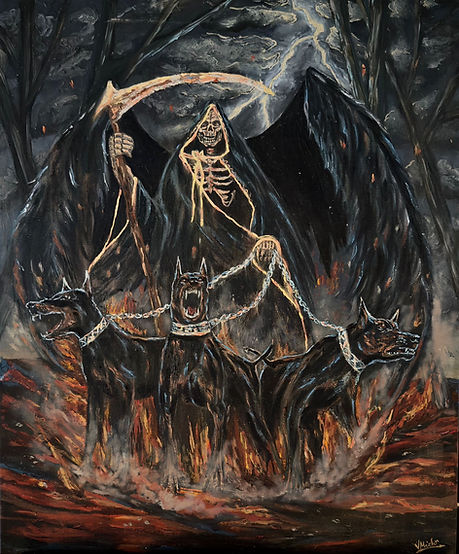
Storytelling is at the heart of my work. I am fascinated by the idea that a painting can become a doorway into another world, another time or another story. My themes can move from contemporary scenes to history, Western worlds, myths and legends, symbolic imagery and imagined realities, but they are connected by the same desire to create atmosphere and a sense of presence. Even when I work with a contemporary subject, such as a motorcycle, I am interested in creating more than an object portrait — I want to build a complete scene, atmosphere and story around it. I am particularly drawn to contrasts such as light and darkness, strength and vulnerability, freedom and control, reality and imagination. History and cultural memory also inspire me, not as something to reproduce literally, but as material from which new visual stories can grow. My long-term artistic project is developing into a collection of different worlds, each with its own character and narrative, while remaining connected by one recognisable visual language. I want viewers not only to recognise what they see, but to experience the mood of the work and discover their own relationship with the story.
What inspires your creative process?
My creative process often begins with an atmosphere rather than a complete image. It may be a particular light, a fragment of a story, a historical reference, a machine, a landscape, a character or simply a mood that stays with me. From there, I begin to build the scene around that initial feeling — developing the composition, environment, colour relationships and lighting until the idea becomes a complete visual world. I am inspired by cinema, history, architecture, nature, mythology and by paintings I have studied in museums. Looking closely at historical painting has taught me a great deal about light, composition, colour and the way an image can carry emotion across centuries. I do not want to reproduce these influences literally; I prefer to absorb them and transform them into something personal. Very often, one small detail becomes the starting point for an entire painting, and the final work develops gradually as I search for the right emotional tension and visual balance.
Can you tell us about a recent artwork or project?
One recent work that is particularly important to me is Harley-Davidson Old Retro Café. The starting point was the motorcycle itself, but I did not want to create a conventional vehicle portrait. I wanted the Harley to exist as a character within a complete cinematic scene. The surrounding environment, vintage mood and lighting were developed to give the painting a sense of place, time and story. For me, the motorcycle represents more than a machine; it carries ideas of freedom, individuality, movement and memory. This work became an important step in the development of my Premium Motorräder collection, where I explore how machines can become emotional and narrative subjects rather than simply technical objects.
What challenges have influenced your development as an artist?
One of the greatest challenges — and at the same time one of the most valuable parts of my development — has been finding my own way as an artist without following the traditional path of an art school or academy. Much of what defines my work today has developed independently through continuous practice, observation, experimentation and solving artistic problems for myself. This forced me to understand not only how to paint something, but why a painting works as a whole. Over time, I became particularly interested in colour relationships and in building an entire painting around a unified palette, connecting the subject, environment, light, shadows and reflections rather than treating them as separate elements. Finding these principles for myself has gradually shaped both my technique and my artistic identity. I see this independent path not as a limitation, but as an important part of what has made my visual language personal to me.
What role does art play in your life today?
Art has become a central part of my life and my professional identity. It is no longer simply something I do in my free time, but the work around which I build my days, my ideas and my long-term direction. Painting has also changed the way I look at the world — I notice light, places, objects, characters and small details differently because almost anything can become the beginning of a new work. At the same time, art gives me the freedom to build something entirely my own, step by step. Every finished painting is not only an individual artwork, but also another part of the larger artistic world and career I am developing.
What are you currently working on?
Since the interview was prepared, the Glamour Bunnies works have been completed, and two of them have been selected for the international online group exhibition Out of the Ordinary at Clover Gallery in Germany. I am now continuing to develop several of my collections, with a particular focus on larger-format narrative works. One of my current directions is my Western series — atmospheric scenes with cowboys, movement, adventure and cinematic light. These works allow me to explore storytelling, tension and a sense of freedom within my artistic language.
What are your future goals as an artist?
My goal is to continue building a strong and recognisable artistic identity and to develop my collections into complete bodies of work that can stand internationally. I want to reach new collectors, strengthen my presence in international publications and exhibitions, and gradually build long-term relationships with galleries and the wider art world. I also want to continue expanding the larger artistic project behind my work, giving each collection the time and depth it needs to develop. In the long term, I want my work to be recognised not only for individual paintings, but for the distinctive artistic universe they create together.
Where can readers follow your work?
My work can be found on my official website, www.veronika-michalow.de, where I present my collections, available original paintings and current projects. I also share new works and updates on Instagram at @veronika_michalow. My work is also presented internationally on the art platform ArtMajeur, where my profile carries the ArtMajeur Ambassador and Professional Artist badges.
Follow
Veronika Michalow
