

Shirin Neshat: Profile in 7 Key Works + Why Her Art Matters
Brief Introduction to Shirin Neshat
Shirin Neshat, an Iranian-born artist, is among the most influential figures in contemporary global art. For more than three decades, she has explored dualities—female/male, East/West, private/public—through photography, video, and installation. Living in exile and moving between two cultures has deeply shaped the conceptual framework of her practice.
After the Iranian Revolution, Neshat migrated to the United States and studied fine arts at the University of California, Berkeley. Since the 1990s, her focus on representing Muslim women’s identities, the politics of the body, and power relations in post-revolutionary societies has positioned her among the leading political artists of our time.
In Neshat’s work, the image of the woman is not merely a visual subject; it becomes a platform to critique cultural, religious, and political structures. Fair representation is a core principle at No.35, which is precisely why we highlight Neshat’s practice. (Read our Representation Policy)
Why Do Her Multimedia Works Matter?
Neshat’s works are best known for their formal innovation and layered meanings. Using two-channel structures, she stages cultural and gendered tensions not only in content but in form. Many of her videos are designed to play simultaneously on facing walls—one channel may carry a female perspective, the other a male voice; one might present a traditional register, the other an experimental one.
Her choice of black-and-white is not a mere aesthetic preference; it lends a dramatic, near-timeless quality and sharpens the sense of rupture and contrast embedded in the work.
Sound is equally deliberate—female voice, traditional music, male singing, and charged silences are composed with care. The audience is not a passive viewer but an active listener who must navigate suspended narratives, choose a point of view, or sit with unresolved questions.
By challenging patriarchal norms, presenting a complex image of femininity, and weaving Iranian visual traditions into contemporary media, Neshat’s work sits at the center of conversations in contemporary art.
Seven Key Works
1. Women of Allah (1993–1997): The Body as a Political Text
The photographic series Women of Allah marked Neshat’s emergence. It comprises portraits of veiled Iranian women overlaid with Persian calligraphy—often verses by Forough Farrokhzad or religious texts. Many figures hold firearms, a tense constellation of faith, power, and the politicized body.
In the emblematic image Rebellious Silence (1994), a woman in black chador faces the camera; the barrel of a rifle bisects her face as Persian script covers her skin. Her direct gaze forces a confrontation—no encounter remains neutral.
Takeaway for first-time viewers: If you have time for only one image, look for the tension between power and silence.
2. Turbulent (1998): Breaking the Boundary of Voice Through Gender
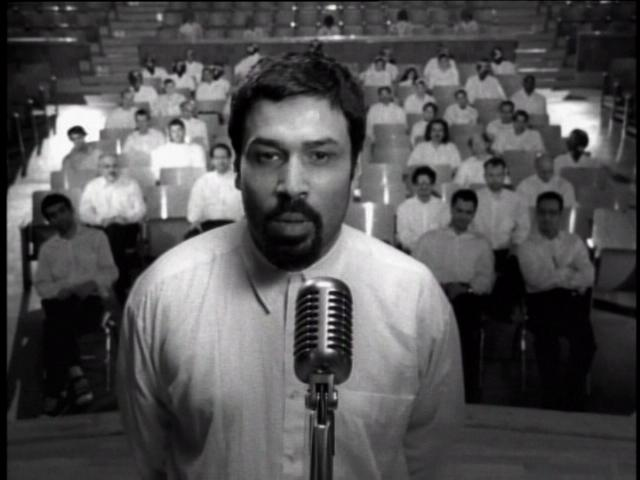
Turbulent adopts the two-channel format. The ten-minute piece projects on adjacent walls. On the left, a traditionally dressed Iranian man sings before an audience of men. On the right, a lone woman faces empty seats; after a long silence, she releases an otherworldly, wordless, experimental vocalization.
The two voices never meet. The man sings and is praised; the woman turns sound into a form of protest.
Takeaway for first-time viewers: Notice the audience on each side—who is seen and who is merely heard?
3. Rapture (1999): Two Walls, Two Worlds, One Counterpointed Narrative
Rapture returns to the dual-screen structure with a more complex narrative. Projected on facing walls, one channel shows a group of men in a traditional, built environment; the other shows veiled women in open landscapes—shoreline and sea.
Takeaway for first-time viewers: Track who remains enclosed and who heads for the horizon—there are many layered metaphors here.
4. Fervor (2000): Ritual Separation and Minimal Storytelling

In Fervor, Neshat again employs the two-channel video, this time centering on ritual spaces. A spare narrative unfolds: a man and a woman cross paths in the street without speaking or touching. They enter a mosque where men and women, seated apart yet simultaneously present, attend a religious gathering.
Takeaway for first-time viewers: Watch how physical distance produces emotional distance; the silences speak volumes.
5. Passage (2001): Image and Music in a Timeless Landscape
Passage, a single-channel video, marks a collaboration with composer Philip Glass. Filmed on the rocky coast of Essaouira, Morocco, its non-linear structure intercuts a group of traditionally dressed women carrying a body across desert terrain with men constructing a ritual structure.
Takeaway for first-time viewers: Follow the choreographed rhythms; the women’s movement drives the narrative.
6. Zarin (2005): A Psychoanalytic Portrait of an Exhausted Body
Zarin, part of the multi-media project Women Without Men, traces the life of a sex worker in Tehran. In a public bath, the men’s faces blur—eyeless, expressionless. Cut like a fever dream, the installation follows Zarin through various spaces.
Takeaway for first-time viewers: Notice how the erasure of others’ faces shifts what—and who—becomes visible.
7. Land of Dreams (2019–2021): Turning to America and a Collective Imagination
Land of Dreams includes over 100 photographic portraits and a two-channel video following a migrant woman who collects people’s dreams for a surreal “registry.”
Takeaway for first-time viewers: Look into the sitters’ eyes—what do their dreams reveal about the self?
Awards and International Impact
Neshat won the International Prize at the Venice Biennale in 1999 for Turbulent and Rapture, and the Silver Lion at the 2009 Venice Film Festival for Women Without Men. Her work is held in major collections worldwide, including MoMA, Tate Modern, and the Whitney Museum.
She has helped expand global visibility for women artists from West Asia and North Africa, positioning her at the forefront of political art.
Further Reading
The Guggenheim Museum
The Museum of Modern Art (MoMA)
Whitney Museum of American Art
Brooklyn Rail
Gladstone Gallery
Goodman Gallery
Museo Reina Sofía
KM21 (The Hague)
Smarthistory


Comments